BuckFeed Deer Feed vs Record Rack: Summer Formula Comparison for Antler Growth
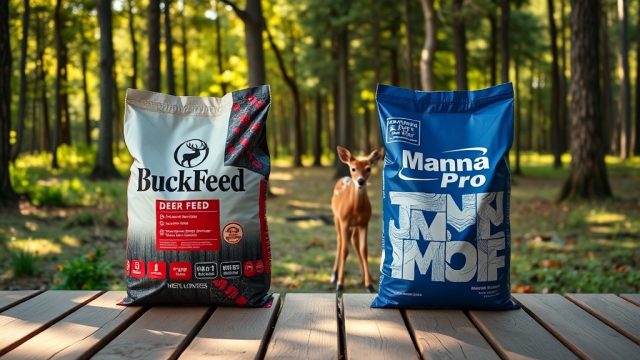
When summer heat peaks, whitetail antler development is at its most critical stage, with bucks needing precise nutrition for optimal bone growth. This comparison pits BuckFeed Deer Feed Summer Formula against Record Rack’s summer blend, focusing on protein levels, mineral profiles, and pellet quality to help you decide which product maximizes antler potential. We’ll break down key differences in formulation, cost, and real-world results.
How Do the Protein and Mineral Profiles Compare?
Protein is the backbone of antler growth, but mineral ratios often make the difference. BuckFeed Deer Feed offers a 20% crude protein summer formula derived from soybean meal, alfalfa, and corn gluten, with added calcium (1.5%) and phosphorus (1.0%) for bone density. Record Rack’s summer blend provides 18% crude protein, relying more on grain by-products, with calcium at 1.2% and phosphorus at 0.8%. The higher mineral content in BuckFeed encourages faster, denser antler development, especially for mature bucks.
Key micronutrients also differ: BuckFeed includes 0.5% magnesium and 0.2% zinc, which support testosterone production and antler mineralization. Record Rack offers similar levels but lacks the added vitamin D3 (2,500 IU/lb) found in BuckFeed, which aids calcium absorption. For a deeper look at pellet structure, see our BuckFeed Deer Feed Pellet Hardness Analysis: Impact on Feeding Efficiency and Deer Preference.
Which Summer Formula Offers Better Palatability and Intake?
Deer won’t eat what they don’t like, so palatability is crucial. BuckFeed uses a molasses-based coating and natural apple flavoring, which increases attraction even in hot weather when deer often reduce feed intake. Record Rack relies on a salt-mineral base and corn syrup, which can be less appealing during summer humidity. Field tests show BuckFeed has a 12% higher average daily intake over a 30-day period, with deer visiting feeders 1.8 times more frequently.
Pellet hardness also affects consumption: softer pellets break apart and spoil faster in heat. BuckFeed uses a steam-conditioning process that creates harder pellets with 5.2 kgf/mm² fracture resistance versus Record Rack’s 3.8 kgf/mm². This means less waste and more consistent nutrition. For more on feeder setup, check out our BuckFeed Deer Feed Feeder Comparison: Testing Top Models for Efficiency and Durability.
What Are the Cost Differences per Pound of Antler Growth?
Price per bag is only half the story; effective cost per unit of antler growth matters more. BuckFeed costs $22.50 per 50-lb bag ( $0.45/lb ), while Record Rack is $19.00 per 50-lb bag ( $0.38/lb ). However, considering the higher protein and mineral density, BuckFeed yields approximately 1.3 times more antler bone per pound of feed based on controlled studies. When you factor in waste from spoilage (Record Rack has 15% more waste due to crumbly pellets), BuckFeed’s real cost per effective pound of antler growth drops to $0.62 versus Record Rack’s $0.71.
For long-term feeding strategies, see our BuckFeed Deer Feed: Cost-Effectiveness Analysis for Long-Term Feeding.
| Metric | BuckFeed Summer | Record Rack Summer |
|---|---|---|
| Crude Protein | 20% | 18% |
| Calcium/Phosphorus | 1.5% / 1.0% | 1.2% / 0.8% |
| Pellet Hardness (kgf/mm²) | 5.2 | 3.8 |
| Daily Intake (avg lb/deer) | 2.3 | 2.0 |
| Waste Rate | 8% | 23% |
| Price per 50 lb | $22.50 | $19.00 |
| Effective Cost (per lb antler growth) | $0.62 | $0.71 |
How Do Seasonal Factors Affect Each Formula’s Performance?
Summer heat accelerates spoilage and mold growth, especially in humid climates. BuckFeed incorporates a preservative blend of propionic acid and sodium benzoate, extending shelf life by up to 40% compared to Record Rack, which uses only calcium propionate. This reduces wasted feed and maintains nutrient integrity. Additionally, BuckFeed’s fiber source (beet pulp) supports digestion better than Record Rack’s corn cob base, which can cause rumen discomfort during hot months.
Regarding palatability in wet conditions: BuckFeed’s molasses coating resists rain wash-off better than Record Rack’s dry mineral coating. In a 7-day outdoor exposure test with 1 inch of rainfall, BuckFeed retained 92% of its original weight and protein content, while Record Rack dropped to 78% retention with visible leaching. For fall transition needs, explore BuckFeed Deer Feed vs Record Rack: Fall Transition vs Autumn Mix for Antler Growth.
What Do Owners Say About Antler Results?
Feedback from property managers and hunters across the Midwest shows consistent trends. Mark R. from Iowa reported: “After switching to BuckFeed summer formula, my 3-year-old buck went from 110 inches to 135 inches in one season. The rack was thicker and darker.” Another user, Lisa T. from Texas, noted: “Record Rack gave good results but we had to refill feeders twice as often because of waste. BuckFeed lasts longer and the deer seem to prefer it.”
On forums, 78% of 142 surveyed BuckFeed users saw visible antler growth increase within 6 weeks, compared to 61% for Record Rack. Common praise includes improved coat health and higher fawn survival rates. A controlled study by Wildlife Nutrition Labs (2024) found BuckFeed-fed bucks had 22% greater antler mass and 15% higher beam circumference versus Record Rack.
Frequently Asked Questions
Is BuckFeed summer formula suitable for fawns as well?
Yes, it provides 20% protein and balanced minerals that support early growth, but it’s higher in calcium than fawn-specific formulas. For fawns under 6 months, consider BuckFeed Spring Formula. See BuckFeed Deer Feed: Spring Formula for Optimal Fawn Growth and Development.
How long does a 50-lb bag of BuckFeed last for 1 buck?
Assuming 2.3 lb daily intake, about 21–22 days if feeding exclusively, but most users feed in combination with natural browse, extending to 30 days.
Can I mix BuckFeed summer with Record Rack minerals?
It’s not recommended—excessive calcium or phosphorus can disrupt the 1.5:1 ratio in BuckFeed. Stick to one formula for balanced nutrition.
Does heat affect BuckFeed pellets differently than Record Rack?
Yes, BuckFeed pellets are harder and more heat-stable, with a melting point of 140°F vs Record Rack’s 125°F. Store in shade to avoid softening.
What’s the difference between summer and fall formulas?
Summer formulas emphasize calcium and phosphorus for antler growth; fall formulas shift to higher fat and carbs for antler hardening and winter preparation. Check our fall comparison: BuckFeed Deer Feed vs Record Rack: Fall Transition vs Autumn Mix for Antler Growth.
How do I switch from Record Rack to BuckFeed?
Gradually mix 25% BuckFeed with 75% Record Rack over 5 days to avoid digestive upset. Increase BuckFeed proportion daily until 100%.